
Airsoft Tech Corner
Airsoft Tech Corner: High-Torque vs High-Speed Motors – Which One Is Right for Your AEG?
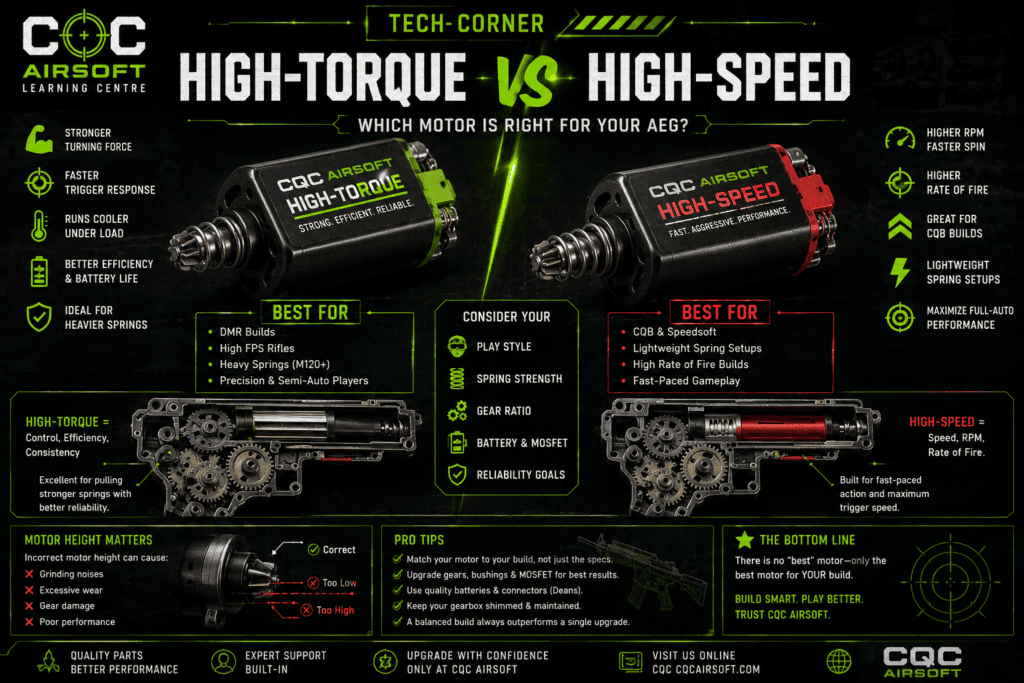
Jul
Choose an AEG motor by matching its torque, speed and compatibility to your complete gearbox setup. A high-torque motor may suit a build focused on semi-auto response and handling load. A high-speed motor may suit a carefully configured build targeting a higher cycling rate. Neither label guarantees better performance on its own.
This CQC Airsoft Tech Corner guide explains the differences, what to check before ordering, and why your gears, spring, battery and electronics matter as much as the motor.
What Does an Airsoft AEG Motor Do?
The AEG motor turns a pinion gear that drives the gearbox gear train. The gears draw the piston back, compress the spring and release the piston during the firing cycle.
The motor must provide enough torque to move the drivetrain under load. Its operating speed helps determine how quickly the gearbox cycles, alongside the gear ratio and the rest of the system.
What Is a High-Torque Motor?
A high-torque motor is designed to provide turning force for the gearbox load. In conventional brushed motors, torque-oriented designs often trade some unloaded speed for their operating characteristics under load.
A suitable motor can help a correctly assembled gearbox start and cycle reliably. It may improve semi-auto response compared with a factory motor that struggles with the existing setup.
Where a Torque-Oriented Motor May Fit
- Builds focused on responsive semi-auto operation
- Gearboxes whose spring and gear combination requires more torque
- Replacement of an inadequate or worn factory motor
- Balanced upgrades where reliable cycling matters more than maximum rate of fire
Do not assume every motor advertised as high torque will run cooler, use less power or outperform another motor. Those results depend on the specific motor and the load it is driving.
What Is a High-Speed Motor?
A high-speed motor is designed for a higher rotational speed under its specified test conditions. In a suitable gearbox, this can increase cycling speed and sustained rate of fire.
The complete drivetrain must still cope with that speed. Feeding, piston return, gear engagement and electronic cycle control can become limiting factors.
Where a Speed-Oriented Motor May Fit
- Builds with a defined cycling-rate target
- Gearboxes assembled and tested for faster operation
- Configurations with compatible feeding and electronic control systems
A CQB or Speedsoft loadout does not automatically need a high-speed motor. Field rules and your preferred firing mode may make controlled semi-auto operation the more useful goal.
Trigger Response vs Rate of Fire
Trigger response describes the delay between pulling the trigger and firing. Rate of fire describes how many shots the system completes over time during sustained operation.
Fast unloaded motor RPM does not automatically mean the fastest first shot. Startup behaviour, torque under load, gear ratio, battery condition and electronics all contribute to response.
A suitable torque-oriented motor may improve the first shot in a demanding setup. A faster motor may shorten cycle time in another. Compare the complete configuration rather than choosing from the label alone.
How to Read Motor Specifications
RPM and Test Voltage
Check the voltage used for the advertised RPM and whether the figure is an unloaded measurement. RPM figures measured under different conditions are not directly comparable, and unloaded speed does not predict the exact rate of fire in your rifle.
Magnets and Motor Construction
Many aftermarket motors use neodymium magnets. Magnet choice matters, but windings, construction, cooling and operating load also affect performance. A magnet specification alone does not establish efficiency, temperature or battery runtime.
Brushed vs Brushless Motors
Brushless motors add electronic motor control and do not follow every assumption used to compare conventional brushed motors. Check the specific manufacturer’s electrical requirements and compatibility guidance.
For brushless models, verify supported MOSFET or ETU settings, particularly active braking and other motor-control functions. Use the motor and electronics manufacturers’ instructions for the exact combination.
Matching the Motor to Your Gearbox
Gear Ratio and Spring Load
Gear ratio changes the relationship between motor rotation, gearbox speed and mechanical advantage. A lower numerical ratio can increase cycling speed but also changes the torque demanded from the motor.
A stronger spring adds load. Do not select a motor from a spring label alone: gearing, friction, assembly quality and battery performance also matter.
Battery, Wiring and Electronics
Use the battery chemistry and voltage approved for your rifle and installed electronics. A motor upgrade does not automatically make an 11.1V LiPo suitable.
Check wiring condition, connectors and the current requirements of the system. A correctly installed MOSFET or ETU can control motor current, but it cannot correct a binding gearbox or guarantee compatibility with every motor.
Physical Fit
Confirm the required shaft length, motor dimensions, pinion compatibility and fit in the grip or motor cage. Long-shaft and short-shaft motors are not interchangeable simply because both are sold for AEGs.
Diagnose Problems Before Buying a Motor
Slow cycling or excessive heat can indicate a motor problem, but similar symptoms can come from other parts of the rifle.
- A depleted, damaged or unsuitable battery
- Loose connectors or damaged wiring
- Incorrect motor height or pinion engagement
- Gearbox friction, poor shimming or worn components
- A spring and gear combination that overloads the system
- Incompatible electronic settings
Stop using the rifle if it grinds, repeatedly jams, produces a burning smell or becomes unusually hot. Have the cause checked rather than repeatedly pulling the trigger or increasing battery voltage.
Why Motor Height Matters
Motor height affects how the pinion engages the bevel gear. Incorrect engagement can create noise, friction and accelerated wear.
A replacement motor may need its engagement checked even when it is the correct shaft type. Follow the rifle manufacturer’s procedure or use an experienced technician. Motor height adjustment cannot compensate for incompatible gears or poor gearbox assembly.
Common Motor Upgrade Mistakes
Choosing the Highest RPM Available
More speed is useful only when the drivetrain, feeding system and controls can support it. Excessive cycling speed can contribute to overspin, feeding problems or damaging piston engagement.
Expecting a Motor to Improve Accuracy
The motor drives the gearbox. It is not a direct accuracy or range upgrade, and it does not set muzzle energy. Hop-up performance, BB quality, air seal and barrel condition remain separate considerations.
Replacing Parts Without a Clear Goal
Decide what you want to improve before ordering. A healthy factory motor may already meet your needs. There is no requirement to replace every drivetrain component, but each change should be compatible with the parts you keep.
Which Motor Should You Choose?
For a healthy stock rifle that meets your needs, keeping the factory motor is a reasonable choice.
For an upgrade, begin with your exact rifle model, shaft type, gear ratio, spring configuration, approved battery and installed electronics. Then select a motor whose specifications match your intended use.
If semi-auto response is your priority, consider startup performance and torque under load. If sustained rate of fire is the goal, confirm that the complete system can handle the proposed speed.
Browse airsoft AEG motors at CQC Airsoft, or contact CQC with your rifle model and current setup before purchasing. Include the problem you want to solve and your total upgrade budget.
Frequently Asked Questions
Will a high-speed motor increase my FPS?
Not directly. The motor changes gearbox cycling characteristics rather than setting muzzle velocity. Chronograph the completed setup after modifications to check its operation and field compliance.
Does a high-torque motor improve trigger response?
It can, particularly when the existing motor struggles with the load. The result depends on the motor, gearing, battery, electronics and gearbox condition.
Do I need a MOSFET with a new motor?
Not every replacement requires one. Check the motor and rifle requirements. A properly wired MOSFET can reduce the load on mechanical trigger contacts; brushless motors may also require specific compatible electronic settings.
Can I install a stronger spring without changing the motor?
Possibly, if the complete system can handle the additional load. Check the gearbox, gears, motor, battery and electronics together, and verify the resulting muzzle energy against your field’s limits.
Which motor is best for a beginner?
A working factory motor is often sufficient. If replacement is needed, choose a compatible model suited to the existing setup rather than assuming the fastest or most expensive option is best.
Will a new motor make my AEG more accurate?
Not by itself. Diagnose accuracy issues through BB quality, hop-up adjustment, barrel condition and the air system rather than treating motor replacement as an accuracy fix.
