
Airsoft Tech Corner
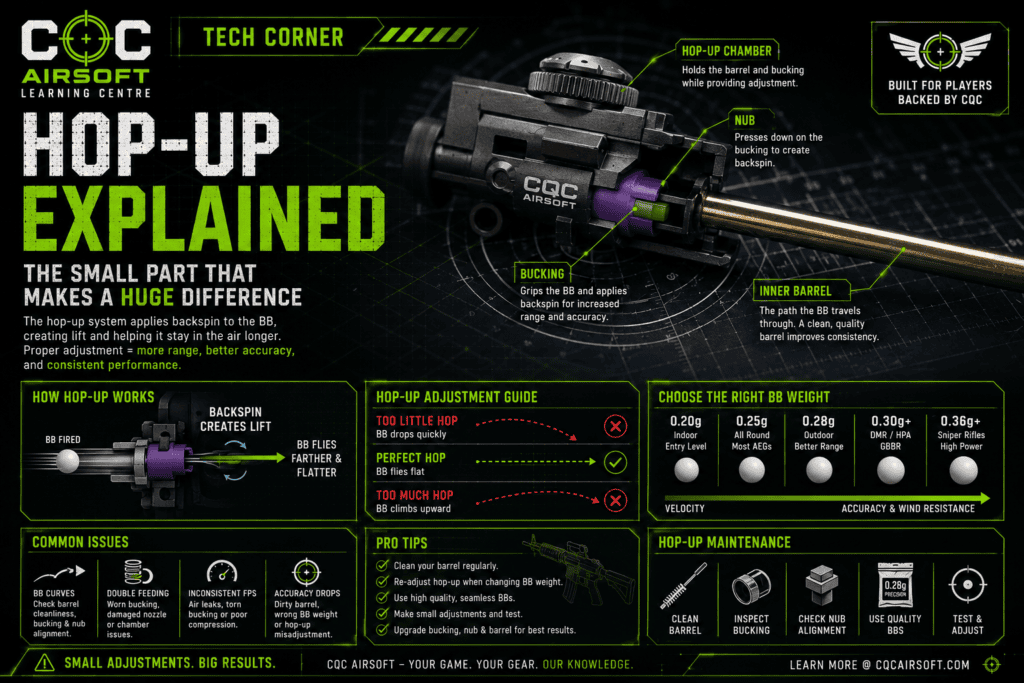
Airsoft Tech Corner: Hop-Up Explained – The Small Part That Makes a Huge Difference
Jul
Airsoft Hop-Up Explained: How Backspin Works
What is an airsoft hop-up, and why does it matter? A hop-up is a component found in many airsoft devices that influences how a lightweight plastic BB travels through the air. Its primary purpose is to create backspin, which changes the aerodynamic forces acting on the projectile.
Understanding the basic science behind this system helps explain why projectile weight, air resistance, component condition, and manufacturing consistency can affect flight behaviour.
In this CQC Airsoft Tech Corner guide, we explore the science of backspin, the purpose of common hop-up components, and the importance of responsible equipment maintenance.
What Is an Airsoft Hop-Up?
A hop-up is a mechanical system that introduces rotational motion to a projectile. This rotation produces an aerodynamic effect that changes its flight path.
Although the principle is relatively straightforward, the behaviour of a spinning object in moving air involves several interacting forces.
The Science Behind Backspin
Understanding the Magnus Effect
The Magnus effect describes how a spinning object moving through a fluid, such as air, can experience a force perpendicular to its direction of travel.
NASA’s Glenn Research Center provides an educational explanation of the aerodynamic lift generated by a spinning ball.
When an object rotates, the airflow around it becomes asymmetric. This can generate an additional aerodynamic force and alter the object’s trajectory.
Why Spin Changes Flight Behaviour
The influence of spin depends on several factors, including rotational speed, forward velocity, object dimensions, air density, and surface characteristics.
NASA also discusses these relationships in its educational resource about airflow around spinning objects.
These principles apply to many moving objects, including sports balls and lightweight recreational projectiles.
Understanding the Main Hop-Up Components
Hop-Up Chamber
The chamber houses the system’s associated components. Its design varies between equipment platforms and manufacturers.
Bucking
The bucking is commonly a flexible component associated with the contact surface that influences projectile rotation.
Material condition and manufacturing consistency are important considerations when assessing the condition of such components.
Nub
The nub is another part of the assembly that helps distribute mechanical pressure. Different manufacturers use different shapes and materials.
Inner Barrel
The inner barrel provides the passage through which the projectile travels. Its condition and dimensional characteristics are part of the overall mechanical system.
Why Manufacturing Consistency Matters
Two components with similar advertised dimensions may differ in manufacturing quality, material properties, surface finish, and dimensional consistency.
Understanding this distinction is useful when evaluating technical specifications. A numerical measurement alone does not establish overall component quality.
Understanding Projectile Weight and Aerodynamics
The flight of a moving object depends on its mass, velocity, aerodynamic drag, and other environmental factors.
Lightweight projectiles can be particularly sensitive to changes in airflow. Wind and atmospheric conditions may influence their movement.
The principles of aerodynamic lift and drag are discussed in NASA’s educational guide to the lift of a spinning soccer ball.
Common Signs of Equipment Wear
Unexpected Changes in Behaviour
Unusual changes in equipment performance may indicate wear, contamination, or another mechanical issue. Such changes should be evaluated according to the manufacturer’s instructions.
Visible Component Damage
Cracking, deformation, or other visible damage can indicate that equipment requires professional assessment.
Unusual Sounds or Mechanical Resistance
Equipment that produces unfamiliar sounds or behaves abnormally should not be repeatedly operated. A qualified technician can assess the condition of its components.
Responsible Maintenance and Inspection
Maintenance schedules vary according to manufacturer guidance, environmental exposure, equipment age, and frequency of use.
Owners should follow the manufacturer’s safety documentation and avoid attempting unfamiliar internal repairs.
Professional inspection is appropriate when equipment shows signs of damage, abnormal operation, or electrical problems.
Why Understanding Airsoft Technology Matters
Learning how a mechanical system functions can help owners recognize the difference between normal operation and potential maintenance concerns.
It also encourages responsible handling, careful attention to manufacturer instructions, and informed discussions with qualified service providers.
Frequently Asked Questions
What does an airsoft hop-up do?
It introduces backspin to a lightweight projectile, influencing the aerodynamic forces acting on it during flight.
What is the Magnus effect?
The Magnus effect is an aerodynamic phenomenon in which a spinning object moving through air experiences an additional force that can alter its trajectory.
Does projectile weight affect flight?
Yes. Mass is one of several factors that influence projectile motion, alongside velocity, drag, rotation, and environmental conditions.
Can worn components affect equipment behaviour?
Yes. Mechanical wear and damage can contribute to abnormal operation. A qualified technician should assess suspected internal problems.
How often should equipment be inspected?
Inspection intervals should follow manufacturer guidance and account for usage conditions and equipment history.
Does the Magnus effect apply only to airsoft?
No. It also applies to spinning sports balls and other objects moving through fluids.
Final Thoughts
The airsoft hop-up provides an example of how mechanical design and aerodynamic principles interact.
Understanding backspin, manufacturing consistency, and the basic physics of projectile motion offers useful educational context for responsible airsoft ownership.
Continue exploring the CQC Airsoft Learning Centre for more educational information about equipment safety, mechanical principles, and responsible maintenance.
