
Airsoft Tech Corner
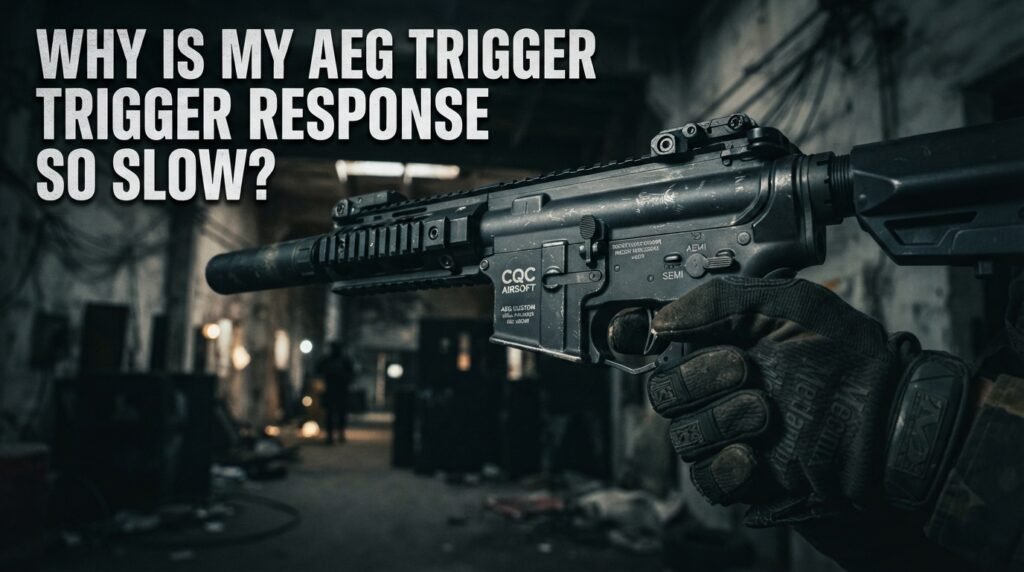
Why Is My AEG Trigger Response So Slow
Nov
CQC AIRSOFT LEARNING CENTRE / TECH CORNER
Slow AEG Trigger Response: 10 Common Causes Explained
Reading Time: 10 Minutes | Difficulty: Beginner to Intermediate
Why Is My AEG Trigger Response So Slow?
Slow AEG trigger response is one of the most frustrating problems airsoft players experience. You pull the trigger, but your rifle hesitates before completing its firing cycle.
Maybe your AEG feels sluggish in semi-auto. Maybe it takes noticeably longer to fire than it used to. Or perhaps you’ve installed a new battery, motor, or MOSFET, but the performance still isn’t what you expected.
The good news? Slow AEG trigger response doesn’t always mean you need an expensive gearbox rebuild.
Sometimes the cause is a weak battery, poor electrical connection, or excessive mechanical resistance.
In this CQC Airsoft Learning Centre Tech Corner guide, we’ll explore 10 common causes of slow AEG trigger response, explain how different components affect cycling performance, and help you understand when professional servicing may be necessary.
At CQC Airsoft, we believe understanding your equipment is the foundation of reliable performance.
Understanding AEG Trigger Response
Before troubleshooting, it’s important to understand what trigger response actually means.
Trigger response describes the delay between pulling the trigger and the gearbox completing the firing cycle.
Inside a conventional AEG, several components work together:
Trigger → Electrical System → Motor → Gearbox → Piston → Shot
When you pull the trigger, the electrical system supplies power to the motor.
The motor drives the gearbox gears, which pull the piston backward against the spring.
Once released, the piston moves forward and compresses air to propel the BB.
The speed and efficiency of this process affect how responsive your rifle feels.
A properly functioning AEG should cycle consistently without unusual hesitation, grinding, or electrical interruptions.
01 // Weak or Discharged Battery
One of the most common causes of slow AEG trigger response is insufficient battery performance.
As battery voltage drops under load, the motor may struggle to cycle the gearbox as quickly as expected.
Common Symptoms
- Sluggish semi-auto response
- Slower gearbox cycling
- Reduced rate of fire
- Inconsistent performance
- Rifle struggling near the end of a game
Battery condition matters just as much as its advertised specifications.
An older battery may show an acceptable resting voltage but experience excessive voltage sag when the motor draws current.
CQC Tech Tip: Before investigating the gearbox, test with a known-good, manufacturer-approved battery. Never use a damaged, swollen, or overheating LiPo.
02 // Poor Electrical Connections
Your battery can be in excellent condition, but poor electrical connections may still reduce performance.
Electrical resistance can develop around:
- Battery connectors
- Motor terminals
- Wiring connections
- Trigger contacts
- Damaged wiring
- Loose electrical terminals
Higher resistance reduces the voltage available to the motor and can generate unwanted heat.
What You Might Notice
Your AEG may feel sluggish, cycle inconsistently, or occasionally fail to respond.
A qualified technician can inspect the electrical system and identify damaged or poorly connected components.
03 // Motor Performance
The motor is responsible for driving the entire gearbox.
If the motor cannot provide sufficient torque under load, the gearbox may cycle slowly.
Motor performance depends on several factors:
- Motor design
- Available torque
- Operating speed
- Magnet strength
- Battery performance
- Gear ratio
- Spring load
- Mechanical resistance
A motor advertised with a high RPM isn’t automatically the best choice for fast semi-auto response.
In many applications, a properly matched torque-focused motor can provide more responsive initial acceleration than an unsuitable high-speed motor.
The goal is to match the motor to the drivetrain, not simply purchase the fastest motor available.
04 // Excessive Gearbox Friction
Your gearbox contains several moving components that need to operate smoothly.
Excessive resistance can slow the motor and increase electrical demand.
Possible Sources
- Incorrect shimming
- Worn bearings
- Damaged bushings
- Gear misalignment
- Damaged gear teeth
- Improper lubrication
- Internal component interference
A gearbox with excessive friction may also produce unusual noise or heat.
Why It Matters
Even a powerful motor cannot compensate efficiently for a gearbox that is mechanically binding.
If your rifle suddenly becomes slower and noisier, stop using it until the cause is identified.
05 // Incorrect Motor Height
Motor height affects how the motor pinion engages with the gearbox’s bevel gear.
Incorrect engagement can create unnecessary resistance.
Possible Symptoms
- High-pitched whining
- Harsh mechanical noise
- Increased motor temperature
- Sluggish cycling
- Premature gear wear
Motor height should be evaluated alongside gear alignment and shimming.
Randomly turning the motor adjustment screw isn’t a reliable solution.
CQC Tech Tip: A smooth, correctly aligned drivetrain is often more valuable than an expensive motor installed into a poorly adjusted gearbox.
06 // Gear Ratio Doesn’t Match the Build
Gear ratios affect how the motor’s rotation is transferred through the gearbox.
Common AEG gear ratios include:
- 18:1: Common standard configuration
- 16:1: Balanced performance option
- 13:1: Faster potential cycling with appropriate supporting components
Lower-ratio gears generally require fewer motor revolutions per gearbox cycle, but they also change the load placed on the motor.
A lower ratio doesn’t guarantee faster response.
The motor, spring, battery, and gearbox condition must all be considered.
Important
If a gear set creates more load than the motor can comfortably handle, performance may actually become worse.
07 // Spring Load Is Too High
The gearbox motor must pull the piston backward and compress the spring during each cycle.
A stronger spring generally requires more torque.
If the spring load exceeds what the motor and electrical system can efficiently handle, the rifle may cycle slowly.
Possible Symptoms
- Laboured cycling
- Increased motor temperature
- Higher current draw
- Reduced efficiency
- Slow trigger response
Before changing the spring or drivetrain, a qualified technician should evaluate the complete build and ensure it remains within applicable field limits.
08 // MOSFET or ETU Settings
Modern AEGs often include programmable electronic systems.
Depending on the model, an ETU or advanced MOSFET may offer features such as:
- Active braking
- Pre-cocking
- Trigger sensitivity adjustment
- Cycle detection
- Battery protection
- Diagnostic warnings
These features can influence how responsive the rifle feels.
For example, active braking controls how the motor stops after a cycle, while pre-cocking changes the piston’s resting position.
Incorrect settings, incompatible components, or electronic faults may create unusual cycling behaviour.
Always consult the manufacturer’s instructions before changing electronic settings.
09 // Trigger Contact or Sensor Problems
Not every trigger delay comes from the motor or gears.
The problem may begin at the trigger itself.
Traditional AEGs use mechanical electrical contacts.
Electronic trigger systems may use optical, magnetic, or microswitch-based sensors.
Potential Problems
- Worn mechanical contacts
- Damaged trigger wiring
- Sensor contamination
- Trigger calibration issues
- Faulty electronic components
Symptoms may include delayed activation, intermittent response, or the rifle failing to recognize some trigger pulls.
Electronic systems should be diagnosed according to the manufacturer’s documentation.
10 // General Gearbox Wear
Sometimes slow trigger response isn’t caused by one failed component.
It can result from gradual wear across several parts.
Over time, components may develop:
- Increased friction
- Bearing wear
- Gear wear
- Reduced electrical efficiency
- Mechanical alignment problems
A rifle that once cycled smoothly may gradually become slower or louder.
Routine inspection helps identify these problems before they lead to more expensive repairs.
Quick Troubleshooting // Where Should You Start?
If your AEG has developed slow trigger response, begin with the least invasive checks.
Step 01 // Battery
Verify the battery is healthy, correctly charged, and approved for the rifle.
Step 02 // Connections
Look for visible connector damage or loose external connections with the battery disconnected.
Step 03 // Listen
Has the gearbox become louder, started grinding, or developed a whining sound?
Step 04 // Recent Changes
Did the problem begin after a motor, battery, gearbox, or electronic upgrade?
Step 05 // Electronics
Check the manufacturer’s documentation for ETU warnings or diagnostic codes.
Step 06 // Professional Inspection
If the basic checks don’t reveal the problem, have the electrical system and drivetrain inspected by a qualified technician.
Important: Avoid repeatedly cycling a rifle that is overheating, grinding, or failing to complete its normal cycle.
Trigger Response vs Rate of Fire
These two performance characteristics are related, but they aren’t identical.
Trigger Response
How quickly the rifle responds to a trigger pull and completes the shot.
Rate of Fire
How many cycles the rifle can complete over a given period during automatic operation.
A rifle can have a relatively high rate of fire but still feel sluggish on the first trigger pull.
Motor acceleration, mechanical load, electronic control, and gearbox configuration all influence the result.
A well-balanced drivetrain matters more than chasing one performance number.
Does a Higher-Voltage Battery Fix Slow AEG Trigger Response?
Not necessarily.
A higher-voltage battery can increase motor speed in a compatible AEG.
However, it cannot repair:
- Damaged gears
- Poor shimming
- Worn bearings
- Faulty wiring
- Incorrect motor engagement
- Mechanical binding
Using an unsupported battery voltage may also damage the rifle’s electrical or mechanical components.
Always follow the manufacturer’s voltage recommendations.
For additional consumer product safety information, visit Health Canada.
Why Consistency Matters More Than Extreme Speed
A fast trigger response can feel impressive.
But speed alone doesn’t make an AEG reliable.
A properly balanced rifle should deliver:
- Consistent cycling
- Predictable trigger operation
- Reasonable operating temperatures
- Reliable feeding
- Smooth mechanical operation
- Long-term component durability
A rifle that performs consistently throughout a full game day is often more useful than one optimized only for maximum cycling speed.
Pro Tips from the CQC Airsoft Tech Bench
- Check battery health before replacing expensive internal components.
- Don’t assume a higher-voltage battery will repair a mechanical problem.
- Match the motor to the gearbox and spring load.
- Investigate unusual gearbox noises immediately.
- Treat motor height and shimming as connected mechanical considerations.
- Follow the manufacturer’s instructions for ETU diagnostics and settings.
- Have damaged electrical connectors professionally repaired.
- Avoid upgrading several components at once without a clear diagnosis.
- Prioritize reliability and efficiency over maximum speed.
- Have complex gearbox and electrical faults evaluated by a qualified technician.
Final Thoughts // Build for Response, Not Just Speed
Slow AEG trigger response can be frustrating, but it often provides an early warning that something in your rifle isn’t operating efficiently.
The cause may be electrical, mechanical, or a combination of both.
A healthy battery, reliable connections, correctly matched motor, and smooth drivetrain all contribute to consistent cycling performance.
The most important lesson?
A faster AEG isn’t always a better AEG. A properly balanced AEG is.
At CQC Airsoft, we believe the best upgrades begin with understanding how the entire system works.
Whether you’re diagnosing sluggish cycling, comparing motors, researching electronic trigger systems, or learning about gearbox maintenance, the CQC Airsoft Learning Centre is here to help you make informed decisions.
Frequently Asked Questions About Slow AEG Trigger Response
Why does my airsoft gun hesitate before firing?
Common causes include a weak battery, electrical resistance, motor performance issues, excessive gearbox friction, or an electronic trigger fault.
Will an 11.1V LiPo improve trigger response?
It may improve cycling speed in rifles specifically designed to support that voltage. It won’t correct underlying mechanical problems, and unsupported voltage can cause damage.
Can bad shimming cause slow trigger response?
Yes. Incorrect shimming can increase mechanical resistance, making the motor work harder and slowing gearbox cycling.
Is a high-torque motor better for trigger response?
A properly matched torque-focused motor can provide good initial acceleration, especially under heavier loads. Actual performance depends on the complete drivetrain.
Does a MOSFET automatically make an AEG faster?
No. A basic MOSFET primarily switches electrical current and protects mechanical trigger contacts. Any improvement in response depends on the original electrical system and the features of the installed unit.
Can a weak battery cause intermittent trigger response?
Yes. A battery experiencing significant voltage sag under load may cause slow or inconsistent cycling.
Why did my AEG become slower after a motor upgrade?
The replacement motor may not be suited to the gearbox, spring, or battery. Incorrect installation or motor-to-bevel engagement may also contribute.
Should I open my gearbox if my trigger response is slow?
Not immediately. Start with safe external checks. If the problem remains, have a qualified technician inspect the drivetrain and electrical system.
CQC Tech Corner // Performance Starts with Efficiency
Don’t chase speed. Build a system that works together.
Explore more educational resources and airsoft equipment at CQC Airsoft Canada.
CQC Airsoft Learning Centre — Your Game. Your Gear. Our Knowledge.
