
Airsoft Tech Corner
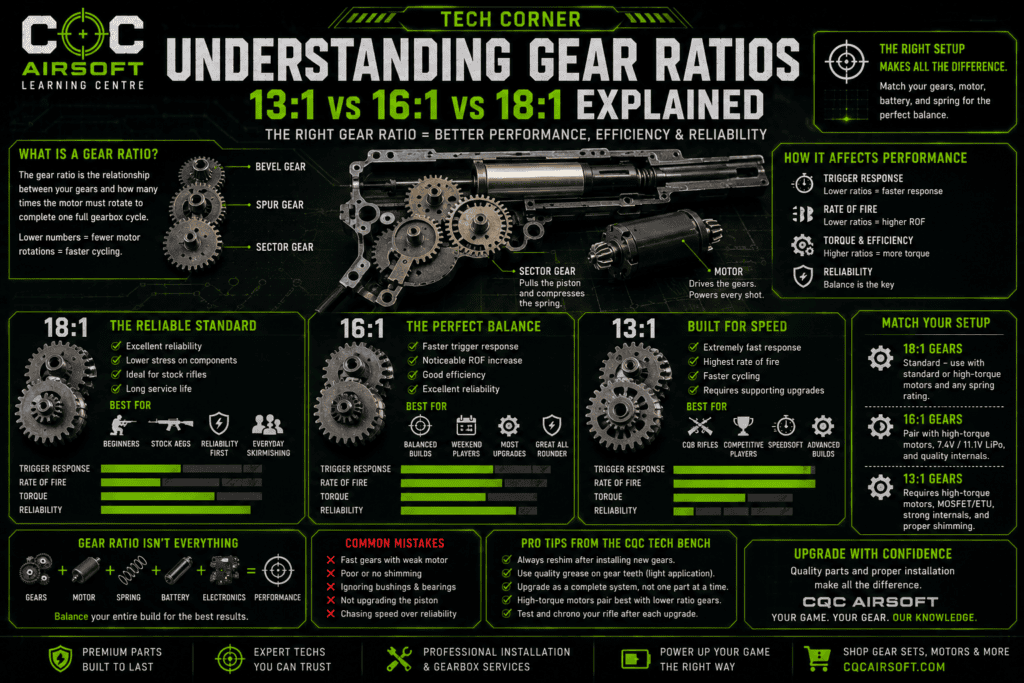
Airsoft Tech Corner: Understanding Gear Ratios – 13:1 vs 16:1 vs 18:1 Explained
Jul
13:1, 16:1 and 18:1 describe different reductions between the motor and gearbox output. In a conventional single-sector AEG setup, a lower numerical ratio needs fewer motor turns per cycle. At the same motor speed, that means faster cycling—but less mechanical advantage.
The right choice depends on your motor, spring, battery, electronics and gearbox condition. This CQC Airsoft Tech Corner guide explains the differences without treating any one ratio as an automatic upgrade.
What Is an Airsoft Gear Ratio?
A conventional AEG gear train uses a bevel gear, spur gear and sector gear. The motor’s pinion drives the bevel gear, and the gear train transfers that motion to the sector gear, which draws the piston back.
For a conventional single-sector arrangement, the advertised ratio describes approximately how many motor revolutions correspond to one sector-gear revolution. One sector revolution normally produces one firing cycle.
Gear-set names are often rounded nominal ratios. Exact tooth counts, proprietary systems and dual-sector designs can change how those labels relate to operation.
13:1 vs 16:1 vs 18:1 at a Glance
| Nominal ratio | Relative cycling speed at the same motor RPM | Main consideration |
|---|---|---|
| 18:1 | Slower than 16:1 and 13:1 | More mechanical advantage than the lower ratios compared here |
| 16:1 | Between 18:1 and 13:1 | A moderate reduction in motor turns per cycle |
| 13:1 | Faster than 16:1 and 18:1 | Less mechanical advantage and greater motor torque demand for the same output load |
This comparison assumes equivalent motor speed and a conventional single-sector setup. A motor’s actual speed changes under load, so the table does not predict your rifle’s exact rate of fire.
18:1 Gears: A Common Conventional Ratio
18:1 is a familiar ratio in conventional AEGs, although factory specifications vary by rifle. Compared with 13:1 or 16:1, it provides more gear reduction and mechanical advantage.
A healthy 18:1 setup can be a sensible choice for everyday play. If your rifle already cycles reliably and meets your needs, changing the ratio may offer little practical benefit.
When Keeping 18:1 Makes Sense
- Your existing drivetrain is healthy and performs as intended.
- You want a compatible replacement rather than a faster cycle.
- Your motor and spring combination benefits from the additional reduction.
The ratio alone does not guarantee durability. Materials, manufacturing, engagement, lubrication and installation all affect service life.
16:1 Gears: An Intermediate Option
16:1 gears reduce the number of motor turns needed per cycle compared with 18:1. At the same motor RPM, they produce a faster sector-gear speed while retaining more reduction than 13:1.
That makes 16:1 an option for builds seeking a moderate change. It is not a universal sweet spot: the result depends on how the motor performs under the new load.
What to Check Before Choosing 16:1
- Whether the current motor can drive the spring and gear combination effectively
- Compatibility with the gearbox shell and related components
- The condition of the piston, gear supports and electrical system
- Whether the expected change addresses your actual performance goal
13:1 Gears: Fewer Motor Turns per Cycle
13:1 gears provide less reduction than 16:1 or 18:1. They can increase cycling speed in a suitable setup, but the motor must provide more torque for the same output load.
A motor that struggles with the new gearing may heat up or cycle poorly. Faster operation can also expose limits in magazine feeding, piston return and electronic cycle control.
Supporting Parts Depend on the Build
13:1 gears do not come with a universal list of mandatory replacements. Assess the existing motor, spring, piston, bushings or bearings, wiring and electronics together.
A suitable motor and correctly configured controls can support responsive operation. They cannot compensate for binding gears, incompatible parts or poor assembly.
Matching Your Motor to the Gear Ratio
The motor must provide enough torque to drive the gearbox through its load. Advertised RPM alone does not establish whether it can do that efficiently.
Lower numerical ratios increase the torque demanded from the motor for the same gearbox output load. A suitable torque-oriented motor may help, but motor labels are not standardized guarantees of performance.
Compare specifications for the exact motor and operating conditions. Read our high-torque vs high-speed motor guide for the related considerations.
How Gear Ratio Affects Trigger Response and Rate of Fire
Trigger Response
Trigger response is the delay between pulling the trigger and firing. Fewer motor turns can shorten a cycle, but motor startup, load, battery condition and electronic settings also influence the first shot.
Changing gears will not necessarily fix slow response caused by a weak battery, damaged wiring or excessive gearbox friction.
Rate of Fire
Rate of fire describes the number of shots completed over time during sustained firing. It depends on loaded motor speed, gear reduction and whether the system can feed and complete each cycle correctly.
Do not calculate an expected rate of fire from advertised unloaded motor RPM alone. Test the completed setup rather than assuming a gear ratio guarantees a specific result.
Battery and Electronics Compatibility
A gear ratio does not determine the correct battery voltage. Follow the rifle, motor and electronics manufacturers’ requirements for the complete configuration.
Installing 13:1 or 16:1 gears does not automatically authorize an 11.1V LiPo. Likewise, the presence of a MOSFET does not confirm that every other component can handle a proposed battery.
A compatible MOSFET or ETU may provide useful current switching or cycle-control features. Available functions and suitable settings depend on the specific device and motor.
Installation Quality Matters at Every Ratio
Gear Fit and Shimming
Check gear clearance and engagement when fitting a replacement set. Existing shims should not be assumed correct for new gears, even when the nominal ratio stays the same.
Correct assembly should allow the gears to rotate without binding while controlling unwanted movement. Use the component manufacturer’s guidance or an experienced technician.
Bushings, Bearings and Motor Engagement
Inspect the gear supports and confirm their fit in the gearbox shell. Check motor pinion engagement and motor height as part of the completed assembly.
Worn supports or incorrect engagement can create friction and wear regardless of the chosen ratio.
Piston Condition and Cycle Timing
Inspect the piston and its engagement with the sector gear. Faster operation must still allow the piston to complete its return before the next pickup.
Repeated double shots, feeding failures, unusual noise or excessive heat need diagnosis. Stop using a malfunctioning setup rather than continuing to test it through repeated firing.
Should You Change Your Gear Ratio?
Keep the existing ratio when the rifle works reliably and already provides the response you need. Maintenance may be more useful than a gearing change.
Consider 16:1 when a moderate reduction in motor turns fits your planned motor, spring and cycling target.
Consider 13:1 when the complete build supports the lower reduction and the resulting speed serves a clear purpose.
Before ordering, identify your exact gearbox platform and verify the gear set’s compatibility. Not every AEG uses interchangeable conventional Version 2 or Version 3 components.
Plan Your AEG Gear Upgrade
Start with a clear goal: replacing worn parts, improving semi-auto response or changing sustained cycling speed. Record your rifle model, current gearing, motor, spring, approved battery and electronics.
Browse airsoft AEG gear sets at CQC Airsoft, or contact CQC with those details to discuss compatible options. Confirm fit before purchasing and test the completed rifle before field use.
Frequently Asked Questions
Will changing the gear ratio increase FPS?
Not directly. Gear ratio changes drivetrain speed and mechanical advantage rather than setting muzzle energy. Chronograph the completed configuration after internal work to verify its performance and field compliance.
Are 13:1 gears better than 18:1 gears?
Neither is universally better. At the same motor speed, 13:1 cycles faster but provides less mechanical advantage. The appropriate choice depends on the complete build and your goals.
Do I need a new motor when changing gears?
Not automatically. Assess whether the existing motor can handle the new ratio and spring load. Replace it only when its performance, condition or compatibility calls for a change.
Can I install new gears without checking the shimming?
No. Check and adjust the shimming and engagement for the replacement set. The previous shim arrangement may not suit the new gear dimensions.
Which ratio is best for most players?
There is no single best ratio. A healthy factory setup may already be appropriate. Choose a different ratio only when it fits a defined goal and the components that will drive it.
Does a lower ratio make an AEG more accurate?
Not by itself. Accuracy and consistency also depend on the hop-up, ammunition, barrel and air system. A faster cycle is a different goal from tighter shot grouping.

Hmm is anyone else encountering problems with the pictures on this blog loading?
I’m trying to figure out if its a problem on my end or if it’s the blog.
Any responses would be greatly appreciated.