
No products in the cart.
HPA Academy
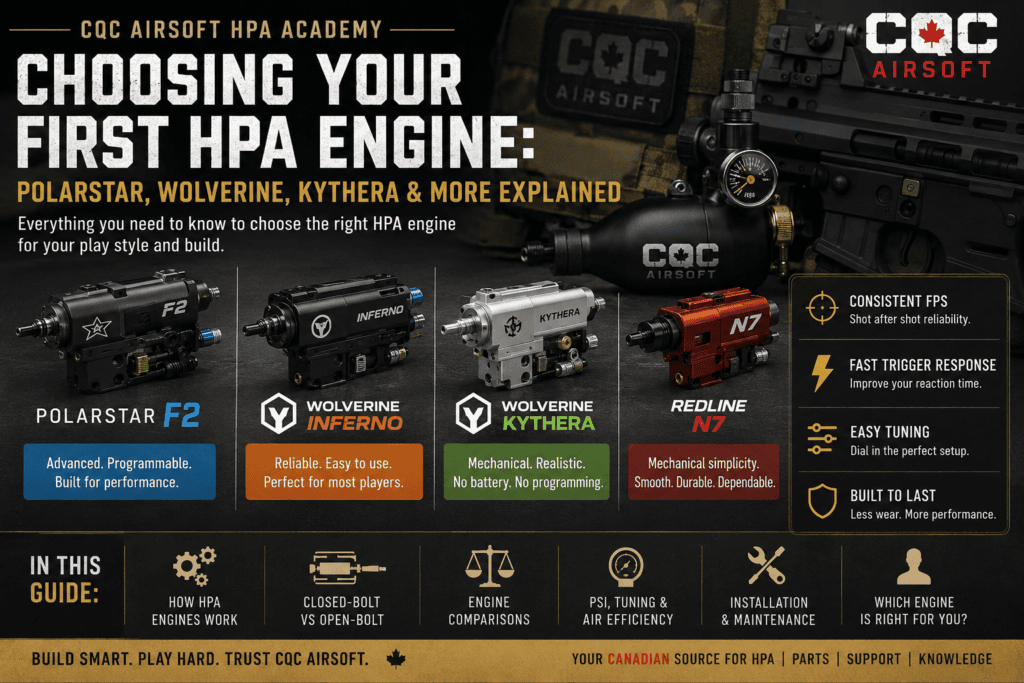
Choosing Your First HPA Engine: PolarStar, Wolverine, Kythera & More Explained
24
Jul
Jul
Choosing Your First HPA Engine: PolarStar, Wolverine, Kythera & More Explained
High Pressure Air (HPA) has become one of the most popular upgrade paths in modern airsoft, offering exceptional consistency, lightning-fast trigger response, and a level of customization that traditional AEG gearboxes simply can’t match. Whether you’re stepping into competitive Speedsoft, building the ultimate MILSIM rifle, or simply looking for a more reliable platform, choosing the right HPA engine is one of the most important decisions you’ll make.
With names like PolarStar F2, Wolverine INFERNO, Wolverine Kythera, and Redline N7 appearing in forums, videos, and discussions across the airsoft community, it’s easy to feel overwhelmed by the options.
In this guide from the CQC Airsoft HPA Academy, we’ll break down exactly how HPA engines work, compare the most popular systems on the market, explain the differences between electronic and mechanical engines, and help you determine which engine is best suited to your style of play.
What Is an HPA Engine?
An HPA engine replaces the internal gearbox components found inside a traditional AEG. Instead of relying on electric motors, gears, pistons, and springs to compress air, an HPA system uses compressed air from an external tank to propel each BB.
A standard AEG relies on numerous moving parts that wear over time:
- Electric motor
- Gearset
- Anti-reversal latch
- Piston
- Cylinder
- Spring
- Tappet plate
An HPA engine eliminates nearly all of these components, replacing them with a precision air system that delivers remarkably consistent shots.
The result is:
- Extremely consistent FPS
- Outstanding trigger response
- Less mechanical wear
- Easier tuning
- Better reliability in all weather conditions
- Quieter operation (depending on setup)
This simplicity is one of the biggest reasons experienced players make the switch.
How Does an HPA Engine Actually Work?
Understanding how an HPA engine works helps explain why these systems perform so well.
Instead of compressing a spring every time you pull the trigger, compressed air is stored inside an HPA tank. That air travels through a regulator and airline into the engine installed inside your gearbox shell.
When you pull the trigger, the engine briefly opens an internal valve, releasing a precisely measured burst of air behind the BB.
Electronic engines use a Fire Control Unit (FCU) to determine exactly when and how long the valve opens. Mechanical engines accomplish the same task using a purely mechanical valve system.
Because the volume of air released is extremely consistent from shot to shot, HPA rifles typically achieve much tighter FPS spreads than most stock AEGs.
Why Do Players Upgrade to HPA?
Players choose HPA for many different reasons.
Some want the fastest trigger response possible for Speedsoft competitions. Others appreciate the consistency required for long-range DMR builds. Many simply want a rifle that’s easier to maintain than a traditional gearbox.
Some of the biggest advantages include:
- Near-instant trigger response
- Outstanding air efficiency
- Consistent muzzle velocity
- Easier tuning
- Reduced gearbox wear
- Better cold-weather performance
- Adjustable FPS using regulator pressure
- Highly reliable operation
For many experienced players, HPA represents the pinnacle of airsoft performance.
Electronic vs Mechanical HPA Engines
Before choosing a specific engine, it’s important to understand the two primary categories available.
Electronic HPA Engines
Electronic engines use a small battery-powered Fire Control Unit (FCU) to control firing.
Popular examples include:
- PolarStar F2
- Wolverine INFERNO
- PolarStar JACK
- PolarStar F1
Electronic systems allow users to adjust numerous settings, including:
- Trigger sensitivity
- Dwell
- Rate of fire
- Burst modes
- Semi-auto response
- Air efficiency
These systems offer incredible flexibility and are widely used in competitive Speedsoft.
Pros
✔ Fastest trigger response
✔ Highly programmable
✔ Excellent efficiency
✔ Adjustable firing characteristics
✔ Multiple fire modes
Cons
- Requires a battery
- More settings to learn
- Slightly more complex installation
Mechanical HPA Engines
Mechanical engines eliminate the FCU entirely.
Instead, the trigger physically activates the firing valve.
Popular mechanical systems include:
- Wolverine Kythera
- Redline N7 Milsim
These systems appeal to players looking for simplicity and realism.
Advantages
- No battery required
- No electronic programming
- Crisp trigger break
- Simple maintenance
- Excellent reliability
Many MILSIM players prefer mechanical systems because the trigger feels much closer to a real firearm.
Closed-Bolt vs Open-Bolt Systems
Another difference between engines is how they chamber and fire each BB.
Closed-Bolt
Closed-bolt systems move the nozzle into position before firing.
Benefits include:
- Better air seal
- Excellent consistency
- Improved accuracy potential
- Reliable feeding
The PolarStar F2 is one of the best-known closed-bolt engines.
Open-Bolt
Open-bolt systems combine the chambering and firing sequence into a single motion.
Advantages include:
- Simpler operation
- Excellent reliability
- Easy maintenance
- High rate-of-fire capability
Many Wolverine engines use variations of this design.
In real-world gameplay, both systems perform exceptionally well, and most players will never notice a significant difference during normal use.
PolarStar F2
The PolarStar F2 has earned its reputation as one of the most advanced HPA engines available today.
Designed for players who want complete control over every aspect of their rifle, the F2 features a dual-solenoid system that independently controls the nozzle and firing valve.
Best For
- Competitive Speedsoft
- Tournament play
- Precision tuning
- High-end custom builds
Key Features
- Independent nozzle control
- Outstanding air efficiency
- Incredible trigger response
- Highly programmable FCU
- Exceptional consistency
The F2 rewards players who enjoy tuning their rifle for maximum performance.
Wolverine INFERNO
The Wolverine INFERNO has become one of the most trusted HPA systems in the industry.
It offers an outstanding balance between simplicity, reliability, and performance.
Unlike more advanced tuning-focused engines, the INFERNO provides excellent results with minimal setup.
Best For
- Beginners
- Weekend players
- Outdoor skirmishes
- General-purpose rifles
Why Players Love It
- Easy installation
- Excellent reliability
- Smooth firing cycle
- Minimal maintenance
- Great air efficiency
For many players, the Wolverine INFERNO represents the ideal first HPA engine.
Wolverine Kythera
The Kythera is unique because it is completely mechanical.
There are:
- No electronics
- No FCU
- No programming
- No battery required
Instead, the trigger directly controls the firing mechanism.
Many players describe the trigger pull as one of the most satisfying available in airsoft.
Best For
- MILSIM
- Tactical gameplay
- Outdoor events
- Players wanting realism
The Kythera proves that simple doesn’t mean sacrificing performance.
Redline N7
The Redline N7 is another highly respected mechanical HPA engine.
Its straightforward design focuses on consistency and reliability rather than electronic customization.
Highlights
- Smooth trigger
- Reliable operation
- Quiet performance
- Easy maintenance
- Excellent durability
Players who prefer mechanical systems often compare the Redline N7 directly with the Kythera when choosing their build.
PolarStar F2 vs Wolverine INFERNO
This is one of the most common questions new HPA players ask.
| Feature | PolarStar F2 | Wolverine INFERNO |
|---|---|---|
| Ease of Setup | Moderate | Easy |
| Tuning Options | Extensive | Moderate |
| Trigger Response | Outstanding | Excellent |
| Air Efficiency | Excellent | Excellent |
| Maintenance | Low | Very Low |
| Price | Higher | Slightly Lower |
| Best For | Competitive Players | Most Players |
If you enjoy tuning every setting, the PolarStar F2 is difficult to beat.
If you simply want a dependable, high-performance rifle that’s easy to own, the Wolverine INFERNO is often the better choice.
What Else Do You Need?
An HPA engine is only one part of the overall system.
A complete setup usually includes:
- HPA Engine
- HPA Tank
- Regulator
- Airline
- FCU & Battery (Electronic Systems)
- Compatible Nozzle
- High-quality BBs
- Chronograph
Many first-time builders forget to budget for these additional components.
Planning your complete build beforehand can save both time and money.
Understanding PSI
One of the biggest advantages of HPA is adjustable performance.
Your regulator reduces the tank’s high pressure to a usable operating pressure for the engine.
Most systems operate somewhere between 60–120 PSI, depending on:
- Barrel length
- BB weight
- Engine design
- Desired FPS
- Local field limits
Higher PSI does not automatically mean better performance.
The goal is finding the lowest pressure that delivers reliable cycling and consistent velocity while staying within your field’s FPS limits.
Always use a chronograph whenever adjusting regulator pressure.
Air Efficiency Explained
Air efficiency refers to how many shots you can fire from a single tank fill.
Several factors affect efficiency:
- Regulator pressure
- FCU dwell
- Barrel length
- Engine design
- Air leaks
- BB weight
Proper tuning can dramatically increase the number of shots you get from each fill without sacrificing performance.
Gearbox Compatibility
Not every HPA engine fits every rifle.
Before purchasing, verify compatibility with your platform.
Common gearbox versions include:
- Version 2 (M4, HK416, AR platforms)
- Version 3 (AK, G36)
- M249
- SR25
- MP5
- Custom platforms
Even rifles using the same gearbox version may require different nozzle lengths depending on the manufacturer.
If you’re unsure, the CQC Airsoft team can help identify the correct engine and nozzle for your rifle.
Does an HPA Engine Improve Accuracy?
This is one of the biggest misconceptions in airsoft.
An HPA engine does not magically make your rifle more accurate.
Instead, it provides consistency, and consistency leads to more predictable shots.
Your accuracy still depends on:
- Hop-up unit
- Bucking
- Nub
- Inner barrel
- BB quality
- Proper air seal
- Correct regulator pressure
A premium HPA engine allows these components to perform at their best by delivering nearly identical air pressure every shot.
Can You Install an HPA Engine Yourself?
Many experienced technicians successfully install HPA engines at home.
However, beginners should expect a learning curve.
A proper installation includes:
- Gearbox preparation
- Correct nozzle alignment
- Airline routing
- FCU wiring (if electronic)
- Regulator adjustment
- Leak testing
- Chronograph testing
Taking the time to install everything correctly ensures years of reliable performance.
Common Mistakes First-Time Builders Make
Avoid these common pitfalls:
❌ Buying the wrong nozzle
❌ Ignoring gearbox compatibility
❌ Using poor-quality BBs
❌ Running excessive PSI
❌ Forgetting to chronograph
❌ Ignoring regulator maintenance
❌ Not checking for air leaks
Learning these fundamentals early will save both money and frustration.
Should You Convert an AEG or Buy a Factory HPA Rifle?
Many players debate whether to convert an existing rifle or purchase a factory-built HPA platform.
Converting Your Existing Rifle
Advantages
- Keep your favourite rifle
- Full customization
- Lower cost if you already own the base gun
Disadvantages
- Installation required
- Compatibility research
- Additional tuning
Buying a Factory HPA Rifle
Advantages
- Professionally assembled
- Factory tested
- Ready to play
- Manufacturer warranty
Disadvantages
- Higher initial cost
- Less customization at purchase
Both approaches have their advantages, and the right choice depends on your budget, experience, and long-term goals.
Which HPA Engine Is Right for You?
| Your Play Style | Recommended Engine |
|---|---|
| First HPA Build | Wolverine INFERNO |
| Casual Weekend Player | Wolverine INFERNO |
| Competitive Speedsoft | PolarStar F2 |
| Tournament Play | PolarStar F2 |
| MILSIM | Wolverine Kythera |
| Realistic Trigger Feel | Kythera |
| Battery-Free Build | Kythera or Redline N7 |
| Simple, Reliable Performance | Redline N7 |
Remember, there isn’t one “best” HPA engine—only the best engine for the way you play.
Is HPA Worth It?
If you’re looking for:
- Faster trigger response
- Better consistency
- Adjustable performance
- Reduced maintenance
- Greater long-term reliability
- Endless upgrade potential
Then an HPA conversion can completely transform your airsoft experience.
While the initial investment is higher than many traditional upgrades, most HPA users agree the performance, reliability, and tunability make it well worth the cost.
Final Thoughts
Choosing your first HPA engine can seem overwhelming, but understanding the strengths of each platform makes the decision much easier.
The PolarStar F2 is built for players who want ultimate performance and endless tuning options. The Wolverine INFERNO offers one of the best balances of reliability, ease of use, and performance, making it an excellent choice for most players. If realism and simplicity are your priorities, the Wolverine Kythera and Redline N7 deliver an authentic mechanical trigger feel without the need for batteries or electronic programming.
At CQC Airsoft, we’re passionate about helping players build reliable, high-performance HPA systems. Whether you’re upgrading your first rifle or creating a competition-ready build, our team can help you choose the right engine, regulator, tank, and accessories to suit your goals.
Visit the CQC Airsoft HPA Academy for more in-depth guides, tuning tips, installation advice, and expert knowledge designed to help you get the most from your HPA setup.
Frequently Asked Questions
What is the best HPA engine for beginners?
The Wolverine INFERNO is widely considered one of the best beginner-friendly HPA engines thanks to its reliability, ease of installation, and excellent performance.
Which HPA engine has the fastest trigger response?
The PolarStar F2 is renowned for its exceptionally fast trigger response and extensive tuning capabilities.
Do all HPA engines require a battery?
No. Electronic systems like the PolarStar F2 and Wolverine INFERNO require a battery for the FCU, while mechanical systems such as the Wolverine Kythera and Redline N7 do not.
Can I install an HPA engine into any AEG?
Not always. Compatibility depends on your gearbox version, receiver dimensions, nozzle length, and other platform-specific factors. Always confirm compatibility before purchasing.
Do I need a regulator?
Yes. Every HPA engine requires a quality regulator to reduce tank pressure to a safe operating range for your rifle.
Is HPA more reliable than an AEG?
Generally, yes. HPA systems have fewer moving parts, experience less mechanical wear, and are less affected by temperature changes, making them highly reliable when properly maintained.
What’s Next in the CQC Airsoft HPA Academy?
Continue your HPA journey with our upcoming guides:
- HPA Regulator Setup & Tuning
- How to Program Your FCU
- Understanding Dwell, PSI & Air Efficiency
- Troubleshooting Common Air Leaks
- Choosing the Right HPA Tank & Regulator
- HPA Maintenance Checklist
- Building the Ultimate HPA Rifle
- HPA vs AEG vs GBBR: Which Platform Is Right for You?
