
HPA Academy
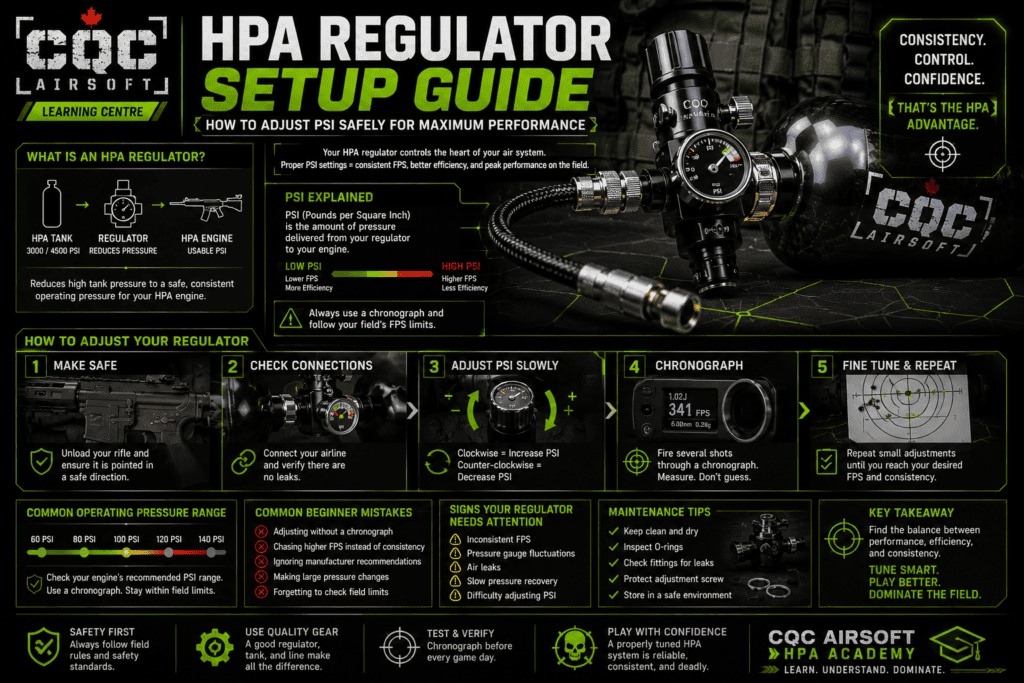
HPA Regulator Setup Guide: How to Adjust PSI Safely for Maximum Performance
Jul
There is no universal PSI setting or adjustment sequence for every HPA rifle. Use the instructions for your exact tank, regulator and engine, then verify the completed setup through your field’s chronograph procedure.
This CQC Airsoft HPA Academy guide explains the pressure terms, compatibility checks and testing habits that help you understand regulator setup.
Tank Pressure vs Engine Operating Pressure
A tank’s storage-pressure rating is different from the output of its attached tank regulator. Many airsoft setups then use a secondary regulator to supply the engine at a much lower operating pressure.
These are separate specifications. Confirm the tank regulator’s output, the secondary regulator’s permitted inlet pressure and the engine’s input requirements.
Some systems integrate regulation differently. Follow the complete air-system diagram for your equipment rather than assuming every setup uses identical components.
What Does PSI Mean?
PSI means pounds per square inch, a unit of pressure. A gauge displays pressure at its measurement point; it does not measure the rifle’s muzzle energy or the volume of air used per shot.
Identify which gauge you are reading. A tank gauge and a secondary-regulator output gauge are not interchangeable readings.
What Does Regulator Pressure Affect?
Input pressure can affect engine operation, velocity and air use. The result also depends on engine design, timing settings, barrel configuration and ammunition.
A regulator setting alone cannot establish accuracy, trigger response or field compliance. Check the complete rifle’s behaviour and measured output.
Check Compatibility Before Connecting
- Identify the exact tank, tank regulator, secondary regulator and engine.
- Confirm that the secondary regulator accepts the tank regulator’s output pressure.
- Confirm that its output range suits the engine.
- Check that lines and fittings have the correct ratings and interfaces.
- Inspect equipment for visible damage and follow required service checks.
Matching threads or connectors do not establish pressure compatibility. If the specifications are unclear, ask the manufacturer or a qualified service provider before connecting the equipment.
How to Approach Pressure Adjustment
1. Find the Matching Instructions
Use the manual for your regulator’s exact model and version, together with the engine setup instructions. Confirm the correct adjustment control, tool, direction and limits.
Do not assume clockwise always increases pressure or that another regulator’s number of turns applies to yours.
2. Prepare a Controlled Test Area
Wear appropriate eye protection, keep the muzzle directed toward a suitable backstop and follow the rifle’s safe-handling procedure. Load ammunition only when ready for controlled chronograph testing.
If you are unfamiliar with connecting the air supply or releasing trapped pressure, have trained field staff or a qualified technician assist.
3. Follow the Prescribed Setup Order
Connect and initialize the system only as directed. Use the manufacturer’s baseline settings for the engine and controller combination.
Make adjustments in the increments specified by the manual. Never exceed a component’s operating limits, force an adjuster or loosen a pressurized fitting.
4. Account for Trapped Downstream Pressure
Some regulators are not self-venting. Turning the adjuster down may not immediately reduce pressure already trapped downstream or change the gauge reading.
Follow the exact manual’s procedure for registering a lower setting. Do not continue turning the adjuster because the gauge has not moved, and do not crack a fitting open to release pressure.
5. Chronograph and Record the Result
Use your intended BB weight and the field’s testing procedure. Measure several shots and check consistency, feeding and normal operation.
Record pressure, ammunition and relevant controller settings. A gauge reading is not a substitute for chronograph testing.
6. Follow the Field’s Locking Rules
After inspection, use the required regulator lock or tournament-lock arrangement. Do not change output settings after approval without following the field’s reinspection process.
Does More PSI Mean Better Performance?
No. Increasing pressure may change output, but it does not automatically improve grouping, range or consistency.
The objective is normal, repeatable operation within the equipment’s specified limits and the field’s rules. Do not chase a pressure number from another player’s rifle.
Pressure and Air Efficiency
Shots per fill depend on tank capacity, fill level, engine operation, leaks and the complete configuration. Pressure alone does not establish efficiency.
For electronic engines, timing settings can also affect air use. Follow the engine and controller manuals rather than reducing pressure or dwell blindly.
Read our HPA FCU programming guide for an introduction to timing terms.
Signs the System Needs Attention
Stop testing and investigate if you notice unexplained pressure rise, persistent leaks, abnormal gauge behaviour, damaged fittings or inconsistent operation.
Inconsistent FPS does not prove the regulator is faulty. Ammunition, hop-up, alignment, leaks and engine settings can also contribute.
Do not compensate for an unexplained fault by repeatedly increasing pressure. Follow the manufacturer’s troubleshooting procedure or arrange qualified service.
Maintenance and Storage
Use the service interval, parts and lubricant specified for the exact regulator. Do not assume every leak requires an O-ring replacement or that any silicone product is suitable.
Isolate the supply and release trapped pressure as directed before servicing. Tank regulators and safety devices require appropriately qualified attention.
Keep equipment clean, protect it from excessive heat and follow the manufacturer’s storage procedure. Never introduce oil or grease into the tank fill path.
Choosing an HPA Regulator
When comparing HPA regulators at CQC Airsoft, start with permitted inlet pressure, output range and compatibility with your engine.
Then consider the connection arrangement, gauge, locking method, service support and package contents. Confirm whether the required line and fittings are included.
Contact CQC with the exact tank and engine models if you need help identifying compatible options.
Frequently Asked Questions
What PSI should I use?
Use the setup procedure and operating range specified for your exact engine and air system. Verify the completed rifle through chronograph testing.
Why does the gauge stay high when I turn pressure down?
A non-self-venting regulator may retain downstream pressure. Follow its prescribed procedure; do not loosen fittings or keep turning the adjuster without understanding the reading.
Can too much pressure damage the engine?
Operating outside the manufacturer’s limits can damage components. Every part in the supply path must remain within its rating.
Should I adjust pressure before every game?
Follow the field’s chronograph requirements. Adjustment is only necessary when the verified setup calls for it, and any change must follow the equipment instructions and field rules.
Does PSI determine accuracy?
No. Accuracy depends on the complete system, including ammunition, hop-up, barrel condition, alignment and consistent operation.
Can I use the same PSI as another player?
Not as a guaranteed setting. Their engine, barrel, ammunition and air system may differ.
Manufacturer Instructions
- Wolverine Airsoft regulator and engine manuals
- PolarStar manuals and downloads
- Ninja Paintball tank and regulator manuals
Continue learning in the CQC Airsoft HPA Academy, including our HPA air-leak guide.
