
HPA Academy
HPA Airsoft Academy: Your Complete Beginner’s Guide to High Pressure Air
Jun
HPA stands for High Pressure Air. An HPA airsoft setup uses regulated compressed air to propel BBs. It can offer responsive operation and adjustable controls, but it also needs compatible air equipment, maintenance and access to refills.
This beginner’s guide from the CQC Airsoft HPA Academy explains the main parts, practical trade-offs and questions to answer before buying.
How Does HPA Airsoft Work?
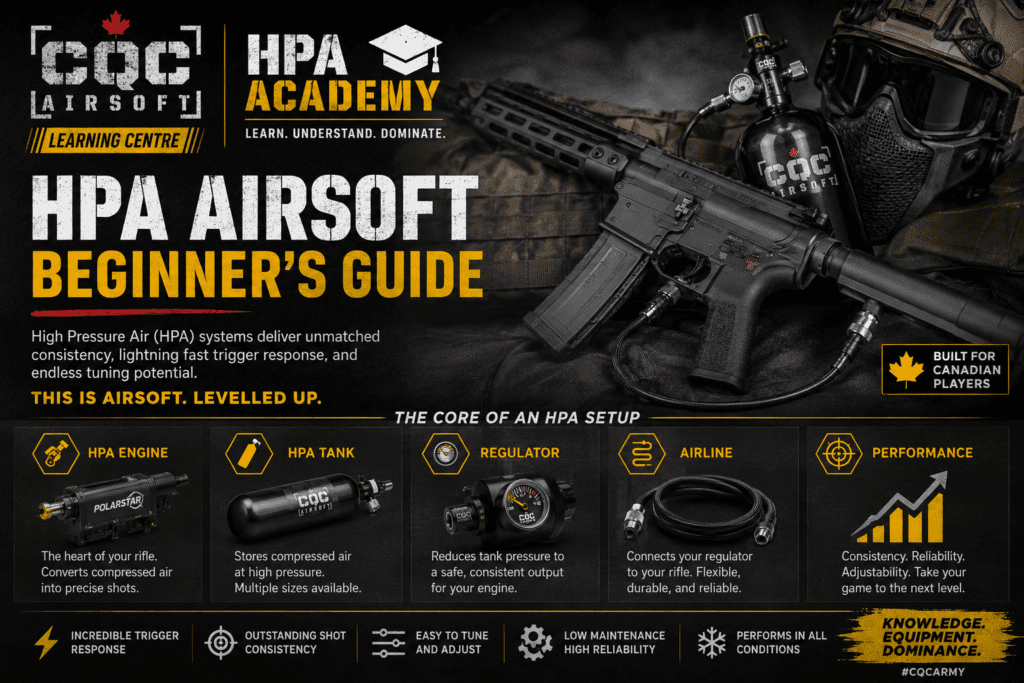
In a typical setup, a tank stores compressed air. Compatible regulation equipment reduces that pressure before the air reaches the engine, which controls the air released for each shot.
Many HPA conversions replace the spring-driven mechanism and drivetrain inside an AEG. Other HPA arrangements use different layouts, including integrated tank systems. Not every HPA gun requires the same external hose configuration.
Correct pressure regulation and component compatibility matter throughout the supply path. A matching connector does not prove that two components can safely work together.
The Main Parts of an HPA Setup
HPA Engine
The HPA engine controls the firing cycle. For an AEG conversion, choose a version that fits the exact rifle, nozzle arrangement and trigger system.
Examples include the PolarStar F2, Wolverine INFERNO and PolarStar Kythera SA. Brand, model and kit configuration are separate details: check the complete listing before comparing features.
Tank and Tank Regulator
The tank stores the air, while its attached regulator controls the output supplied to the next part of the system. Storage-pressure ratings and regulator output pressure describe different things.
Tank capacity, fill level, weight and the efficiency of the complete setup all affect practical runtime. A larger physical tank is not automatically the best choice for every player.
Check the tank’s markings, manufacturer guidance and service requirements with a qualified fill provider before use.
Airsoft Regulator
Many setups use a separate airsoft regulator to supply the engine at its specified input pressure.
Confirm both the regulator’s permitted inlet pressure and its output range. Some regulators require a specific tank-output category. Do not select one from a generic PSI recommendation.
Line and Fittings
Where an external line is required, it must have suitable pressure ratings and compatible connections. Check whether the package includes the remote line, internal grip line and fittings your setup needs.
An internal grip line and the line connecting the tank to the rifle serve different positions in the system; do not assume one product replaces both.
Electronics and Battery
Electronic engines need power for their firing controls. Check the specified battery, charger and space for the controller and wiring.
Mechanical engines do not require a battery for engine operation, although separate accessories may still use batteries.
Electronic vs Mechanical Engines
Electronic systems may provide settings such as dwell, firing modes or cycle timing, depending on the installed controls. They suit players who want those adjustments and are willing to learn the setup process.
Mechanical systems offer a different trigger arrangement without an electronic firing controller. Confirm the supported firing modes and mechanical adjustment requirements for the exact model.
Neither approach is automatically more reliable or more accurate in every installation. For a closer comparison, read Choosing Your First HPA Engine.
Why Players Consider HPA
Responsive Firing
An HPA conversion removes the conventional AEG spring-compression cycle. That can provide responsive operation, although the trigger arrangement, controller settings and engine still affect the result.
Adjustable Operation
Many systems allow adjustment through regulated input pressure and, where supported, electronic settings. Changes must stay within the equipment’s operating limits and be checked through the field’s chronograph procedure.
Shot Consistency
A correctly installed system can provide consistent air delivery. Actual shot consistency also depends on the regulator, air supply, nozzle alignment, ammunition and hop-up.
HPA does not guarantee tighter groups than a well-set-up AEG.
A Different Maintenance Routine
A conversion removes some conventional gearbox components, but it adds pneumatic equipment to inspect and service. Follow the manuals for the engine, tank, regulators and lines.
Fewer gearbox parts does not mean maintenance-free ownership.
Cold-Weather Use
Do not treat HPA as unaffected by temperature. Check the operating limits of the complete system, including regulators, seals and any electronic-control battery.
Test operation and muzzle energy under the conditions in which you intend to play. A setup that works indoors should not be assumed to behave identically in cold or wet conditions.
The Practical Trade-Offs
Total Cost
Budget for the rifle or conversion host, engine, air supply, regulation equipment, lines, electronics where required and installation. Compare complete packages rather than engine-only prices.
Carrying the Air Supply
An external-tank setup needs a secure carrier and sensible line routing. Other configurations place a compatible tank on the rifle. Consider weight, balance and movement before choosing.
Refills
Confirm access to a suitable fill service before buying. Ask your intended field or qualified fill provider whether it supports your tank and what equipment checks it requires.
An ordinary workshop compressor is not an assumed substitute for equipment approved to fill an HPA cylinder.
HPA vs AEG: Which Fits Your Needs?
An AEG may suit you if you prefer battery-powered operation without managing a compressed-air supply. A healthy factory AEG can be a practical starting point.
HPA may suit you if its controls and air-powered operation appeal to you, and you are prepared for the complete equipment cost, refills and maintenance.
Try both at a field if possible. Choose from your budget and practical needs rather than assuming one platform represents a guaranteed performance upgrade.
Can a Beginner Start with HPA?
Yes, provided the beginner has a compatible setup and help understanding its operation. A first-time buyer should plan how to fill the tank, connect and disconnect equipment correctly, and arrange routine service.
A factory HPA rifle may reduce conversion work, but check what is included. It still needs the correct air supply and field checks before play.
Checks Before Your First Game
- Read the manuals for every pressure component and the rifle.
- Confirm tank output, regulator inlet limits and engine input requirements.
- Inspect the line, fittings, tank and regulators for damage.
- Use equipment that meets its applicable service and inspection requirements.
- Have the rifle chronographed with the intended BB weight under the field’s procedure.
- Follow field rules for firing modes and regulator locking.
- Learn the correct isolation and depressurization procedures before use.
Do not loosen pressurized fittings or attempt tank-regulator repairs as a beginner maintenance task. Stop using damaged or leaking equipment and arrange qualified help.
Plan Your First Setup
Before ordering, write down:
- Your exact rifle model, if converting an existing gun
- Your preferred mechanical or electronic controls
- Your total equipment and installation budget
- Where you will obtain suitable air fills
- Your field’s equipment and chronograph requirements
Contact CQC with those details to discuss compatibility and package contents. Visit the HPA Academy for engine, regulator and maintenance guides.
Frequently Asked Questions
What does HPA stand for?
High Pressure Air. In airsoft, it refers to compressed-air propulsion supplied through compatible regulation equipment.
Is HPA more accurate than an AEG?
Not automatically. Accuracy depends on the complete rifle, including hop-up, barrel, ammunition, alignment and air delivery.
How long does a tank last during a game?
Shot count varies with capacity, fill level, engine settings and the complete system’s air use. Do not assume a universal number of shots per tank.
Do all HPA guns need batteries?
No. Electronic firing systems need power; mechanical engines do not require a battery for the engine itself.
Can I adjust FPS?
Many systems allow output adjustment, but only within the manufacturer’s limits. Verify muzzle energy using your intended ammunition and follow the field’s testing and locking requirements.
Can I use any tank and regulator together?
No. Confirm output and inlet-pressure compatibility, fittings and the requirements of the complete system. Matching threads alone are not enough.
Can I use HPA at any field?
Ask the field before attending. Confirm its HPA policy, firing-mode rules, chronograph procedure, regulator-locking requirements and fill availability.
Manufacturer Resources
