

No products in the cart.


HPA Academy
Mechanical vs. Electronic HPA Airsoft: Which System Is Right for You?
15
Aug
Aug
Mechanical vs. Electronic HPA Airsoft: Which System Is Right for You?
If you’re planning an HPA airsoft build, one of the biggest decisions you’ll make isn’t simply which engine to buy.
It’s whether you should go mechanical or electronic.
Both systems use compressed air to power your airsoft rifle, and both can deliver excellent consistency, trigger response, and reliability. But the way they operate—and the type of player they’re best suited for—can be very different.
Should you choose the simplicity of a mechanical engine such as the PolarStar Kythera, or the extensive tuning capabilities of an electronic system such as the PolarStar F2 or Wolverine INFERNO?
In this guide from the CQC Airsoft HPA Academy, we’ll break down the differences so you can choose the system that best matches your playstyle and build.
What Is a Mechanical HPA Engine?
A mechanical HPA engine operates without an electronic Fire Control Unit controlling the firing cycle.
Instead, the trigger mechanically controls the engine.
That means you can eliminate several electronic components normally found in an electronic HPA setup.
Depending on the system, you may have:
- No FCU
- No FCU battery
- No electronic trigger board
- No programming menu
- No electronic fire-control settings
Connect your properly configured air system, chronograph the rifle, and you’re ready to play.
For players who value simplicity, that’s a major advantage.
What Is an Electronic HPA Engine?
An electronic HPA engine uses a small battery and electronic control system to operate one or more solenoids.
The FCU determines how the engine cycles.
Depending on the engine and controller, players may be able to adjust settings such as:
- Dwell
- Rate of fire
- Fire mode
- Burst settings
- Trigger response
- Nozzle timing
- Other engine-specific parameters
Electronic systems provide considerably more tuning flexibility than most mechanical platforms.
Mechanical HPA // Major Advantages
01 // SIMPLICITY
Mechanical engines are appealing because there are fewer electronic components involved.
There is no FCU programming to learn and no FCU battery to remember before game day.
For players who want a straightforward HPA rifle, mechanical systems are hard to overlook.
02 // NO FCU BATTERY
Forgetting to charge or pack an FCU battery isn’t a concern with a fully mechanical engine.
Your compressed-air system provides the energy needed for operation.
This can be especially attractive for longer outdoor events where simplicity and reliability are priorities.
03 // TRIGGER FEEL
Mechanical engines can offer a distinct trigger feel that some players prefer.
Instead of an electronic microswitch or sensor controlling the firing cycle, the trigger interacts mechanically with the system.
This makes mechanical HPA particularly attractive to some:
- MILSIM players
- Semi-auto players
- Outdoor players
- Realism-focused builds
04 // FEWER ELECTRONICS
Rain, moisture, damaged wiring, connectors, and batteries are considerations with electronic systems.
Mechanical HPA removes many of those electronic components from the equation.
That doesn’t make a mechanical engine maintenance-free, but it does simplify the system.
Electronic HPA // Major Advantages
01 // ADVANCED TUNING
This is where electronic HPA shines.
Depending on your engine and FCU, you can fine-tune multiple parameters to match your build.
That makes electronic HPA particularly attractive to players who enjoy optimizing performance.
02 // ADJUSTABLE RATE OF FIRE
Many electronic systems allow rate-of-fire adjustment.
That can help you configure your rifle around:
- Field regulations
- Personal preference
- Air efficiency
- Different styles of play
Always configure your rifle according to the rules of the field you’re playing at.
03 // FIRE-MODE OPTIONS
Depending on the FCU and engine, electronic systems may support configurable firing modes.
These can include:
- Semi-auto
- Full-auto
- Burst modes
Availability varies by system, and your field’s rules always take priority.
04 // EXTENSIVE PERFORMANCE CONTROL
Electronic HPA gives experienced users considerably more control over how the engine cycles.
This is especially useful when you’re optimizing an entire build around a particular barrel, hop-up configuration, BB weight, and field limit.
Mechanical vs. Electronic HPA // Quick Comparison
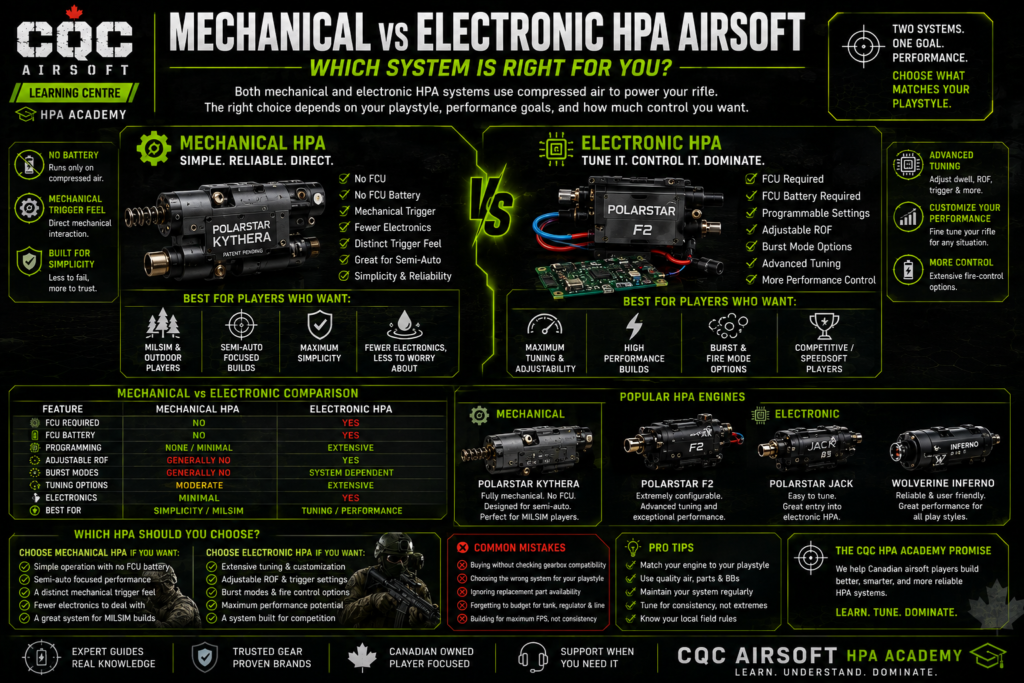
| Feature | Mechanical HPA | Electronic HPA |
|---|---|---|
| FCU Required | No | Yes |
| FCU Battery | No | Yes |
| Programming | Minimal/None | Extensive |
| Adjustable ROF | Generally No | Often Yes |
| Burst Modes | Generally No | System Dependent |
| Tuning Options | Moderate | Extensive |
| Electronic Components | Minimal | Yes |
| Best For | Simplicity / MILSIM | Tuning / Performance |
Neither design automatically makes a better airsoft rifle.
The right choice depends on what you want your rifle to do.
Popular Mechanical HPA Engines
One of the best-known examples is the:
PolarStar Kythera
The Kythera is a fully mechanical HPA system designed around semi-automatic operation.
It’s popular with players who want:
- Mechanical operation
- No FCU battery
- A distinct trigger feel
- A simplified HPA build
It’s especially appealing for outdoor and MILSIM-style rifles.
Popular Electronic HPA Engines
There are several established electronic options.
PolarStar F2
The F2 is designed for players who want extensive control over their HPA setup.
It’s well suited to advanced builds where adjustability and tuning are priorities.
PolarStar JACK
The JACK offers electronic HPA performance in a relatively straightforward package.
It has become a popular option for players looking to enter the electronic HPA world.
Wolverine INFERNO
The Wolverine INFERNO is another popular electronic platform known for combining performance with relatively straightforward operation.
It’s a strong option for both newer HPA players and experienced builders.
Which Is Better for MILSIM?
Mechanical HPA is often an excellent choice for MILSIM.
Why?
Because many MILSIM players prioritize:
- Reliability
- Semi-auto performance
- Simplicity
- Realistic operation
- Fewer electronics
A mechanical system such as the Kythera fits that philosophy extremely well.
That doesn’t mean electronic HPA can’t be used for MILSIM—it absolutely can.
It simply provides capabilities that some MILSIM players may not need.
Which Is Better for Speedsoft?
Electronic HPA will generally make more sense for competitive players who want extensive control over trigger and firing characteristics.
Electronic systems provide the adjustability required for highly specialized builds.
However, field rules always come first.
Extreme settings don’t automatically translate into better performance.
Which Is Better for Beginners?
This depends on the player.
A mechanical system may sound easier because there’s no FCU programming, but mechanical engines still require proper installation and setup.
Electronic systems require learning FCU settings, but once properly configured, they can also be straightforward to operate.
If you enjoy:
Simple equipment → Consider mechanical.
If you enjoy:
Tuning and customization → Consider electronic.
Which System Is More Reliable?
Both can be extremely reliable when properly installed and maintained.
Mechanical systems have the advantage of fewer electronic components.
Electronic systems, however, have been used successfully in airsoft for years and can provide excellent reliability when properly configured.
Maintenance matters more than simply choosing mechanical or electronic.
What About Air Efficiency?
Engine design and tuning have a major impact on air consumption.
Efficiency can be affected by:
- Engine design
- PSI
- Dwell
- Barrel configuration
- Air seal
- Nozzle alignment
- BB weight
- Overall tuning
Don’t choose an engine based purely on claims about shot count.
Look at the complete system.
Common Mistakes When Choosing an HPA Engine
Avoid choosing an engine simply because someone online says it’s the “best.”
Common mistakes include:
❌ Buying without checking gearbox compatibility.
❌ Choosing electronic HPA when you don’t want to tune electronics.
❌ Choosing mechanical HPA when you actually want programmable features.
❌ Forgetting to budget for a tank, regulator, and line.
❌ Ignoring replacement-part availability.
❌ Building around maximum FPS instead of consistency.
The best HPA engine is the one that matches your actual needs.
The CQC HPA Academy Recommendation
Think about your playstyle before thinking about brand names.
Choose Mechanical HPA If You Want:
✔ Simple operation
✔ No FCU battery
✔ Minimal electronics
✔ Semi-auto-focused performance
✔ A MILSIM-oriented setup
Choose Electronic HPA If You Want:
✔ Advanced tuning
✔ Adjustable electronic parameters
✔ Programmable fire-control options
✔ More customization
✔ A performance-focused build
There isn’t one winner for everybody.
There is simply a better system for your build.
Final Word
Mechanical and electronic HPA systems approach the same goal in two very different ways.
Mechanical engines focus on simplicity, direct operation, and reduced dependence on electronics.
Electronic engines focus on control, customization, and extensive tuning capability.
Before buying an engine, determine what kind of airsoft player you are and what you actually expect from the rifle.
Do that first, and choosing your HPA system becomes much easier.
The CQC Airsoft HPA Academy is here to help Canadian airsoft players understand their equipment before spending money on the wrong components.
Learn the system. Build it right. Tune for consistency. Get on the field.
Frequently Asked Questions
Does mechanical HPA need a battery?
A fully mechanical HPA engine does not require an FCU battery to operate.
Does electronic HPA require a battery?
Electronic HPA engines typically require a small battery to power their electronic fire-control components.
Is mechanical HPA better for MILSIM?
It can be an excellent choice because of its simplicity and semi-auto-focused operation, but electronic systems can also work extremely well for MILSIM.
Is electronic HPA better for Speedsoft?
Electronic systems are popular for performance-oriented builds because they offer extensive tuning and trigger-control options.
Is the PolarStar Kythera mechanical?
Yes. The PolarStar Kythera is a mechanical HPA system and does not rely on an electronic FCU for operation.
Is the PolarStar F2 mechanical?
No. The PolarStar F2 is an electronically controlled HPA engine.
Can a beginner use mechanical HPA?
Yes. However, installation and tuning still need to be performed correctly. Mechanical does not mean maintenance-free.
Which HPA system should I buy?
Choose based on your playstyle. If you prioritize simplicity and minimal electronics, mechanical may be ideal. If you want extensive tuning and customization, electronic HPA may be the better choice.
SEO // FOCUS KEYPHRASE
Mechanical vs Electronic HPA Airsoft
Supporting Keywords
- Mechanical HPA vs electronic HPA
- Best HPA engine for airsoft
- PolarStar Kythera vs F2
- HPA engine comparison
- Mechanical HPA airsoft
- Electronic HPA airsoft
- Best HPA system for beginners
- HPA Airsoft Canada
